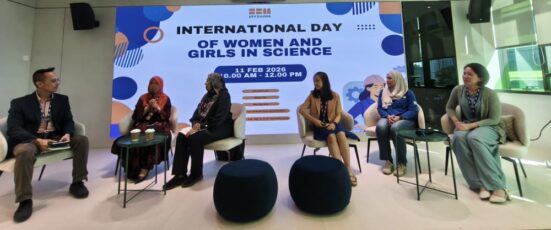
In conjunction with the International Day of Women and Girls in Science, celebrated on 11 February 2026, Assoc. Prof. Eur. Ing. Ir. Ts. Dr. Syuhaida Ismail from the Malaysia-Japan International Institute of Technology (MJIIT), Universiti Teknologi Malaysia (UTM), was invited to serve as a panellist at the forum “Involvements of Women in Engineering”, organised by the Inclusion, Diversity and Equity (IDE) Committee of SBM Offshore.
Aligned with this year’s theme, “From Vision to Impact: Redefining STEM by Closing the Gender Gap”, the session aimed to spark meaningful dialogue and encourage female students to remain resilient in engineering careers, even through major life transitions such as marriage and childbirth.
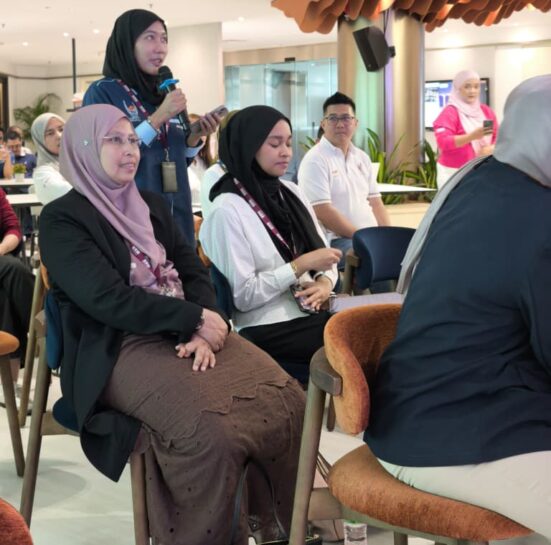
Dr. Syuhaida shared the panel with Ts. Sharifah Zaida Nurlisha Syed Ibrahim from MMC Oil & Gas Engineering Sdn. Bhd., alongside Christine Lim, Wan Nuraiza Rosely, and Alicia Goh from SBM Offshore. The forum drew more than 50 participants, comprising SBM Offshore staff and female Bachelor of Engineering students. The theatre room was filled with thoughtful and persistent questions, reflecting both curiosity and genuine concern about future professional pathways.
The discussion opened with challenges commonly faced by women engineers. As one of the few female engineers holding leadership roles within the Board of Engineers Malaysia (BEM) and the Institution of Engineers Malaysia(IEM), Dr. Syuhaida addressed the recurring question of how women can ensure their voices are heard in professional meetings. The panel highlighted the importance of strategic preparation, including reviewing discussion materials in advance and entering meetings with strong contextual understanding.
Echoing this perspective, Dr. Syuhaida emphasised that in today’s environment—where data is often regarded as the “new oil”—allowing evidence to lead the conversation shifts discussions away from personal positioning towards structured, fact-based problem-solving. Reliable and up-to-date data, the panel agreed, commands professional respect in environments where logic and numbers prevail.
Drawing on more than two decades of experience in academia, particularly in supervising postgraduate students and engaging with high-level professionals, Dr. Syuhaida further elaborated on communication strategies in professional settings. Rather than lengthy rebuttals, posing targeted and analytical questions during interruptions can effectively reset discussions and redirect focus.
This reality is supported by research. A study by the University of California observed that 46 out of 48 interruptions in mixed-gender discussions involved men interrupting women. Meanwhile, George Washington University found that men interrupted female conversational partners 2.1 times within a three-minute conversation, compared to 1.8 times when speaking with other men—a 33% higher interruption rate. Such findings underscore the need for strategic navigation in professional discourse.
When the forum turned to mentorship, a provocative question was raised: does effective mentorship significantly influence women’s retention in engineering? Reflecting on her own journey, Dr. Syuhaida expressed appreciation for mentors who emphasised accountability rather than protection—fostering ownership, clarity, and follow-through. She noted that technical excellence alone does not always speak for itself; documenting impact in alignment with senior management evaluation criteria is equally critical to ensure visibility at decision-making levels.
She considers herself fortunate to be among the estimated 24% of women engineers reported to have senior mentors, although such mentorship came later in her mid-thirties. Among those who significantly shaped her leadership development are Prof. Dr. Awaludin Shaharoum, Emeritus Prof. Dato’ Ir. Ts. Zainai Mohamed, and Prof. Dr. Abd Latif Saleh.
Broader studies reinforce the structural importance of mentorship. Research indicates that 77% of women in technology fields with mentors remain in the industry beyond three years. McKinsey & Company further reports that 59% of women in C-suite roles had female mentors at some point in their careers, yet only 39% of entry-level women report having mentorship support, despite 58% aspiring to leadership positions. The message to young engineers was therefore clear: mentorship should be secured early—formal or informal—as a strategic necessity rather than a privilege.
The forum also explored undervalued competencies in engineering leadership. Beyond the courage to say no when necessary, providing sound justification, and practising active listening, Dr. Syuhaida emphasised the importance of engineering humility. This capability ensures that technically sound solutions are also examined against social, operational, and ethical consequences, preventing unintended impacts on the broader community.
Diversity was discussed not merely as representation, but as a critical safety dimension in engineering decision-making. A panellist from SBM Offshore shared that mixed-gender teams often generate more comprehensive solutions by incorporating varied perspectives. This aligns with findings from Boston Consulting Group, which report that companies with diverse leadership teams generate 19% higher innovation revenue.
Among the most striking moments were the students’ candid questions about whether the panellists would choose engineering again if given another opportunity. Others asked about the transition from being a female engineering student in a relatively structured academic environment to becoming a professional engineer in the broader industry landscape. These questions reflect early-stage uncertainties, signalling the need for stronger systemic reassurance and support structures.
Ultimately, this year’s theme calls for moving beyond aspiration towards measurable impact. Closing the gender gap in Science, Technology, Engineering and Mathematics (STEM) requires more than encouraging women to adapt to existing systems; it demands redesigning systems that were not originally structured with inclusivity in mind. The forum underscored that engineering does not lack capable women—it falters when it fails to create sufficient space for them to thrive without disproportionate pressure to “lean in”.
Beyond such forums, redefining engineering requires tangible implementation through inclusive policies, structured mentorship pathways, and workplace cultures that enable talent—regardless of gender—to mature, remain, and lead. Greater collaboration between industry and academia is essential to address systemic challenges earlier and more strategically. As a profession fundamentally rooted in design, engineering must also be willing to redesign itself.